
I am excited to share we will be receiving a quantum computer.
FIU will become the first university in Florida to acquire a full-stack, trapped-ion quantum computer. Our agreement with IonQ establishes FIU as the company’s flagship academic partner in Florida. Their new Superion 256 system will be installed on our campus in mid to late 2027.
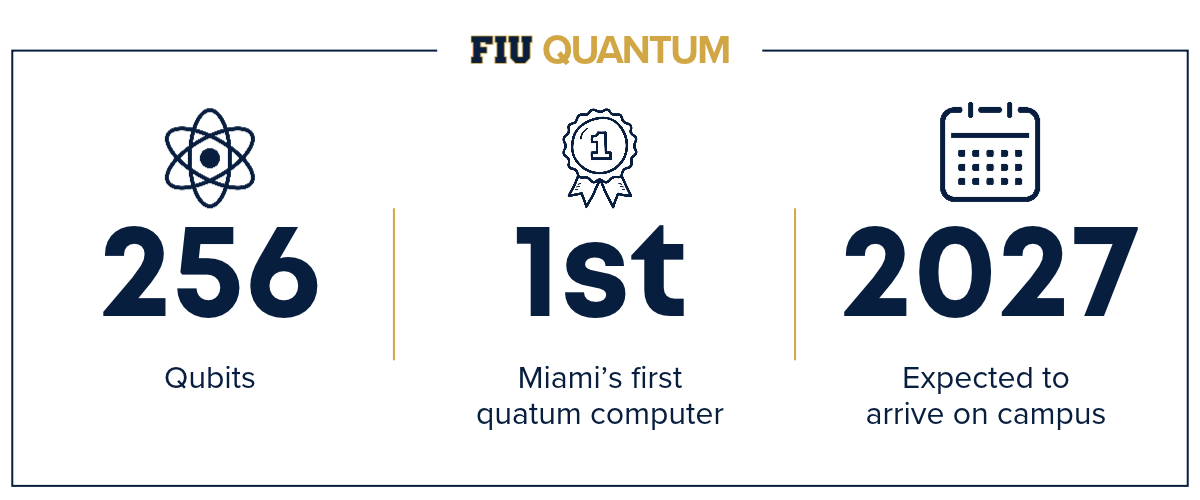
This is not just Miami’s first quantum computer. It is a 256-qubit, trapped-ion, industry-leading system that will expand the capabilities of our university, our partners, and our region.
In this month's message, I want to share some context on how we secured this partnership, provide some examples of the complex engineering and computing questions we may be able to explore, and highlight insight from one of our top quantum computing experts on why this is a game changer for student education.
The right time and place
Our college has been building its quantum ecosystem for years, with students learning cutting-edge methods and technologies through programs like our National Science Foundation-funded research traineeships and our two DoE-funded research initiatives. Meanwhile, our faculty have been generating new knowledge in fields such as quantum materials, quantum AI, quantum algorithms for energy, quantum-safe encryption, and quantum sensors.
Our desire to have an on-campus quantum computer has grown commensurate with our research expansion.
Dr. Arif Sarwat is a Distinguished University Professor of Electrical & Computer Engineering in our College. He serves as the director of the joint Florida Power & Light – FIU Smart Grid Facility and leads the Energy, Power, Sustainability & Intelligence research group. For more than two decades, he has been researching smarter ways to generate, store, and deliver power, including quantum and AI-based solutions.
In recent years, he has focused on how quantum computing could transform his field. His research group has access to one of the largest smart grid databases in the world, which captures changes in energy infrastructure over time. That data presents complex challenges, many of which could benefit from quantum computing.
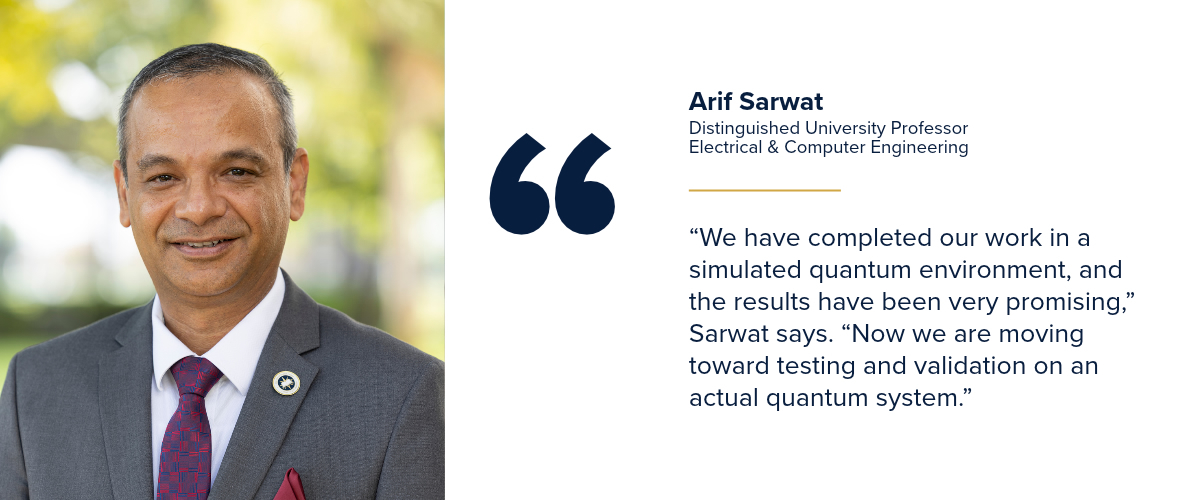
To take that next step, Sarwat spearheaded the partnership with IonQ that led to the university’s acquisition.
The computer will serve researchers across FIU, and we expect many of its earliest users to come from our college.
The technology will be especially useful for solving “systems-of-systems" challenges like energy management, Sarwat says.
“If you ask a student to solve a circuit, they'll be able to do it, because they know the laws behind it. It’s one system,” Sarwat says. “However, many of our challenges today aren’t just one system. They’re systems-of-systems, where not all the parts of the problem fit into one kind of mathematical statement.”
Some problems are just much better addressed through quantum computing. Here are three of many possible examples of the kinds of challenges College of Engineering & Computing faculty may be able to address better with quantum computing.
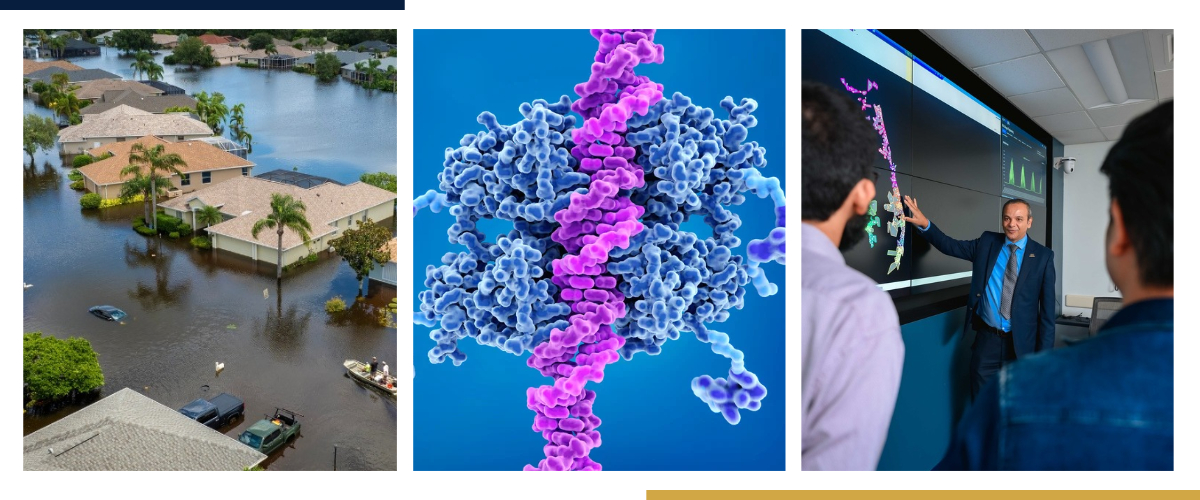
Hurricane impact predictions on coastal communities
Researchers can already model well flooding associated with hurricanes. It’s a complicated process, as I discussed in my last message. But predicting that flooding, perhaps down to the parcel level, and its impact on groundwater processes, transportation, power, critical infrastructure, evacuation, and human behavior is a truly systems-of-systems type problem that Dr. Sarwat alluded to.
An overarching model that captures those interactions could help emergency planners reach a high level of preparedness. They could know when to divert traffic before roads become impassable, where to pre-position emergency or medical assets, or how a power disruption in one location could affect access and evacuation elsewhere.
Rational drug design
Today, drug discovery often relies on brute force. Researchers test thousands of compounds against a disease-related protein, looking for one that alters its activity in the right way. Sometimes none of them do.
Dr. Joshua Hutcheson, founding director of the FIU–Florida Heart Research Foundation Center for Innovation in Cardiovascular Health, thinks quantum computers could offer a much better path.
“It is a quantum mechanics problem. Quantum computers are ideally suited to model that,” says Hutcheson, an associate professor in the Department of Biomedical Engineering.
Proteins function depends on interactions of atoms at the quantum level, which makes them difficult to model even on a classical high-performance computer, Hutcheson says.
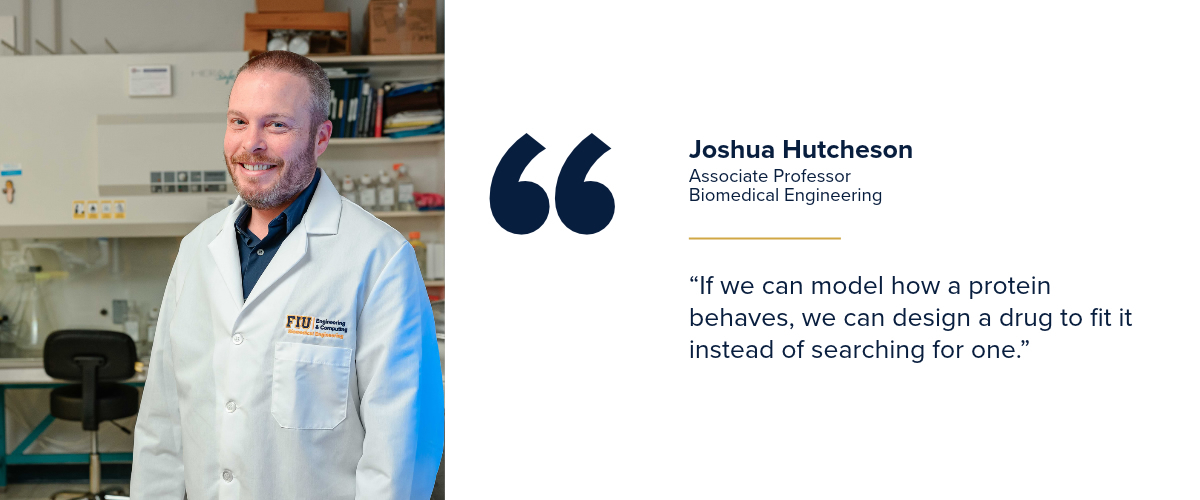
"A more precise drug could also avoid off-target effects, where a drug binds proteins it was never meant to reach and causes side effects. For heart disease and cancer, where treatments must restore our own cells to normal behavior, that precision could make a real difference.”
Resilient energy management
Avinash Jeewani, a Ph.D. student in Sarwat’s lab who also works as a software engineer at Microsoft, is already studying an application for quantum computing.
Jeewani researches how to manage energy across many sources at once. Rather than optimize a single microgrid, he models how to route power from distributed energy resources (DER) and utility-scale plants to the places that need it as weather shifts their output throughout the day.
“Right now, each site gets its own forecast and we add them up at the end,” Jeewani says. “That throws away the fact that the sites are correlated, since the same cloud bank reaches them minutes apart. We want to model them as one connected system, so the grid sees the real combined uncertainty instead of a sum of separate guesses.”
He currently tests his approach on simulated quantum systems. An on-campus quantum computer would let him validate those results on real hardware, using the lab’s smart grid data to see how his models perform under real-world conditions.
Hands-on quantum education
Dr. Alex Krasnok, an assistant professor in the Department of Electrical & Computer Engineering, directs the Quantum Technology & Metamaterials Laboratory. In a recent paper in Nature Reviews Physics, he and his co-authors explain why universities need transparent access to quantum hardware.
Cloud access has limits. Free access to some cloud systems lasts about 10 minutes, and the most advanced machines often remain out of reach.
Running a quantum computer also works more like an experiment than a calculation. On a local machine, researchers and students can use calibration and diagnostic data to compare results across individual qubits and investigate why those results differ.
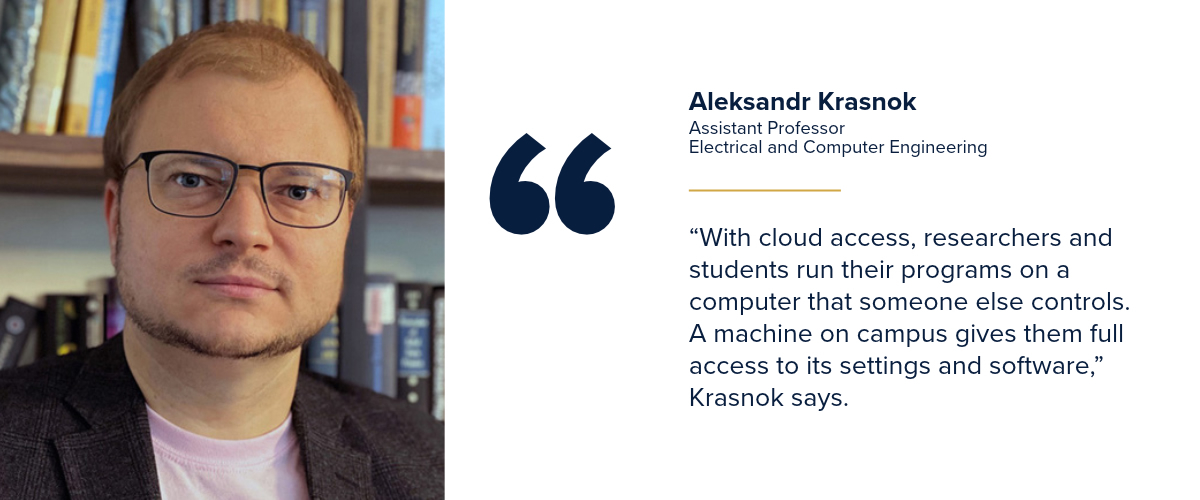
“Using the cloud is like driving a rental car: someone else maintains it, so you never look under the hood. With our own machine, students can open the hood, tune the engine, and see how each adjustment changes its performance.”
That experience will prepare our students as leaders in the quantum workforce.
Looking ahead
For years, many complex problems in engineering and computing have seemed out of reach. We believe this computer and its capabilities will allow us to address them and even problems we have not yet encountered. I look forward to sharing what our faculty and students discover in the years ahead.