
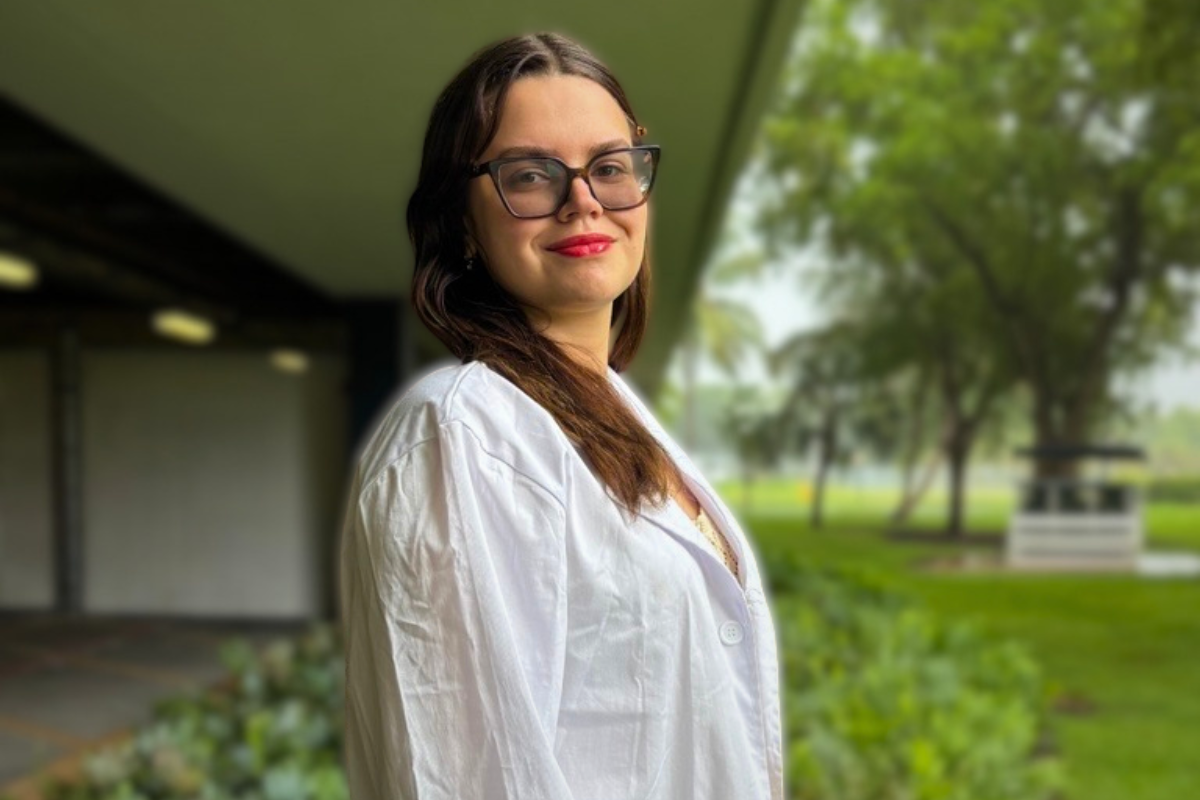
By Adrienne Sylver
In our undergraduate research series, we are bringing you stories of students from the College of Engineering and Computing who are actively engaged in research that could have a broad impact — work that, while still in its early stages, hints at the kind of breakthroughs that could shape their fields for years to come. Today, we profile Elyna Gonzalez.
Q: What is your major, your year and where are you from?
I’m a biomedical engineering student at FIU and I’ll be graduating this summer. I was born and raised in Miami.
Q: Are you in the Honors College and what drew you to it?
Yes. I’ve always been very driven, and I wanted to be in a community of like-minded people. I also felt that it would help me gain leadership skills. Being in the Honors College has pushed me outside of my comfort zone and given me the confidence to pursue opportunities I might not have considered otherwise.
Q: What are you working on in the lab? Explain it like you’re talking to a smart friend who isn’t in your field.
I’ve been involved in both wet-lab and computational research at FIU and the University of Miami. Much of my work focuses on better understanding the neurovascular changes associated with disorders such as Alzheimer’s disease, Parkinson’s disease and other forms of dementia. In the Vascular Physiology and Biotransport Lab, we study the brain’s smallest blood vessels, called capillaries, to better understand how changes in blood flow and vascular function may contribute to these diseases. In the Machine Learning and Data Analytics Group (MLDAG), I work with large neurological datasets and computational tools, including machine learning techniques, to identify potential biomarkers and better understand disease progression.
Q: Why does this research matter? What’s the real-world payoff if things go right?
If we can better understand the biological mechanisms that contribute to these diseases, that knowledge could help guide the development of new therapies or earlier methods of detection. These conditions affect millions of people and have a profound impact on patients and their families. I hope that, through research, I can contribute to improving their quality of life.
Q: How did you end up in this lab?
It was actually a coincidence. I was volunteering at a blood bank event at FIU when another volunteer mentioned a biomedical engineering professor who led the Vascular Physiology and Biotransport Lab. His research aligned with my interests, so I reached out by email and everything started from there.
Q: Walk me through what you actually do when you’re in the lab. What does a typical session look like?
A typical day starts with meeting with the principal investigator or a Ph.D. student to discuss our goals for the day. In the Vascular Physiology and Biotransport Lab, one of my primary responsibilities involved preparing mouse brain tissue for downstream experiments. This included carefully dissecting the brain, isolating the capillaries and collecting them into chilled tubes to preserve the tissue. The samples were then passed on to another researcher for further analysis under a microscope.
Q: How many hours a week are you in the lab and how do you fit it around coursework?
Now that I’m involved in multiple labs, I typically spend between 5 and 15 hours a week doing research. Balancing everything with coursework can be challenging, but it has become much more manageable over time. The experience has made it well worth the effort.
Q: What is your relationship with your mentor like? How hands-on are they with your work?
Every lab has a different mentoring style. In the Vascular Physiology and Biotransport Lab, my first research lab, Niloufar Khakpour was the Ph.D. student I worked with, and Nikolaos Tsoukias, Ph.D., was the PI. Dr. Tsoukias helped me understand the broader scientific goals of our work and always challenged me to think critically. Niloufar was incredibly supportive and patient as I learned new techniques. In the Machine Learning and Data Analytics Group, Dr. Ananda Mohan Mondal is the principal investigator, and I work closely with one of his Ph.D. students, Mezbahul Islam, who provides guidance and support throughout my research. Dr. Mondal encourages our team to use AI to explore new hypotheses and approaches while analyzing large datasets to identify potential biomarkers for Parkinson’s disease.
Q: Has a faculty member or mentor said something to you that genuinely changed how you think about your work or yourself as a researcher?
There have been several moments when conversations with my mentors encouraged me to keep going during challenging times. Those discussions reminded me that setbacks are a normal part of research and motivated me to continue learning and improving.
Q: What’s surprised you most about what research actually is, compared to what you expected going in?
Research is very different from the laboratory experiences most people have in middle school, high school or even undergraduate chemistry courses. Instead of following a set procedure with a known outcome, research is about asking new questions and solving problems that don’t yet have answers. It was especially fascinating to begin working with brain tissue and see firsthand how scientific discoveries are made.
Q: Where do you want to go from here: grad school, industry, something else? Has the research changed what you think you want to do?
I became interested in neurovascular research because when I was a child I developed an infection that triggered a high fever. Due to an underlying genetic mutation that had not yet been diagnosed, the fever led to a seizure. I was later diagnosed with Lennox-Gastaut syndrome, a rare and severe form of epilepsy. I participated in a clinical medication study that ultimately changed my life, and today I no longer require medication. That experience inspired me to pursue research focused on neurological disorders. I see myself continuing in research, whether in academia or industry. Eventually, I hope to earn a master’s degree in electrical engineering to strengthen my background in medical device design and software development, followed by a Ph.D. in molecular biology to better understand the molecular mechanisms underlying neurological diseases. My long-term goal is to bridge engineering and biology by translating molecular discoveries into technologies that improve the detection, monitoring and treatment of neurological disorders, perhaps through wearable or other intelligent medical devices.
Q: If you could say one thing to a high school senior or incoming freshman who’s curious about research but doesn’t know how to get started, what would you tell them?
Look up professors in your major and learn about the research they conduct. Make a list of the two or three whose work interests you most, then send them a brief email introducing yourself. Include what interests you about their research, your resumé and any relevant accomplishments or skills. You have nothing to lose by reaching out, and that one email could open the door to opportunities you never expected.