

Sixty days into my tenure as Dean of FIU's College of Engineering & Computing, I'm inspired by our faculty who are generating new knowledge, then applying that knowledge to address critical needs.
Many of our faculty are leaders in their respective fields. Today, I’d like to highlight the work of Professor Arjuna Madanayake from our Department of Electrical & Computer Engineering.
He's tackling a challenge that's central to modern defense: how the U.S. and our allies can counter drones.
Inexpensive to fabricate, hard to detect and difficult to shoot down, drones are wreaking havoc in conflicts around the world.
Detection is one of the hardest parts of that challenge, particularly when it comes to small drones. They have such a small radar cross-section that conventional systems often miss them. Meanwhile, acoustic systems can be overwhelmed by background noise.
Dr. Madanayake is carving a new path. He asks: Is there some other way to detect drones that we haven’t fully explored yet?
To find that answer, he’s recalling something he worked on years ago: how to communicate with a submarine hundreds of feet underwater.
Sources: National Science Foundation Higher Education Research and Development Survey; National Academy of Inventors; FIU
Working alongside researchers Soumyajit Mandal at Brookhaven National Laboratory and Chatura Seneviratne at the University of Ruhuna, Sri Lanka, he studied extremely low frequency signals, a type of radio wave with a very long wavelength, to see how they can be used to transmit a signal underwater.
The project came back to mind years later as he was thinking about drones, and whether they give off any unintended signals that a warfighter can exploit.
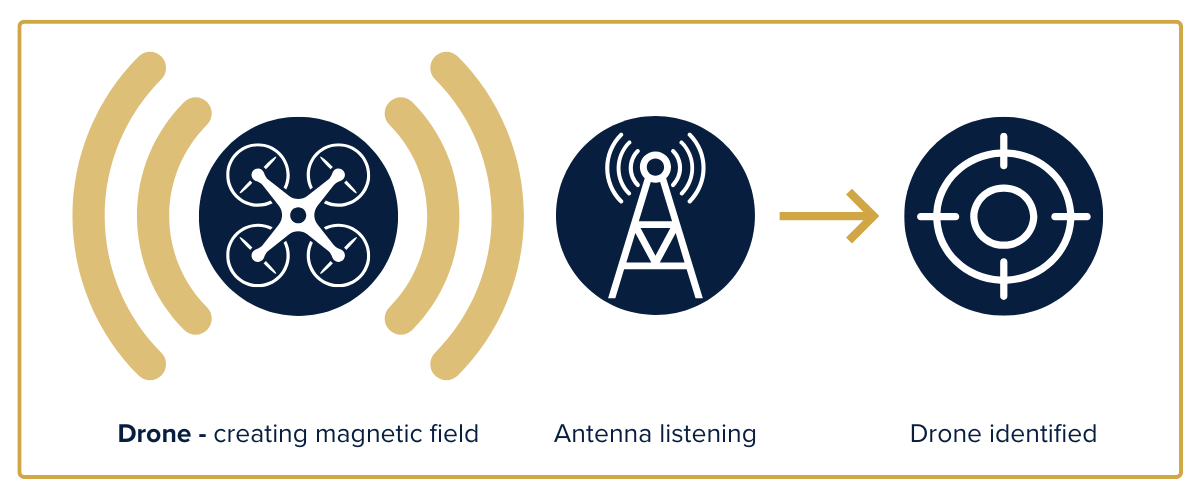
Inspiration struck. Small drones have propellers. They are spun by motors, which contain magnets. Those magnets create a magnetic field as they spin. The byproduct: an extremely low frequency signal, just like the ones he studied for reaching submarines.
If this signal is being unintentionally created by drones, could it be exploited to identify them? In IEEE Sensors, Dr. Madanayake presents how his team built an antenna that “listens” for these radio signals passively, without transmitting any signals, so there's nothing for an adversary to detect in return.
They then connected the antenna to an algorithm that was trained to read these signals as unique “fingerprints” that could be assigned to different kinds of drones. The result: In testing, the system identified which drone was flying with up to 98% accuracy. Detection range depended on the type of drone and on the detection algorithm used.
“While the range of our method is limited for now, it costs only a few hundred dollars to develop and could run continuously without any specialized support, unlike radar systems. That opens the door for forward operating bases, border crossings and other places that need protection but can't support a full sensor installation,” Dr. Madanayake says.
Importantly, his method reveals not just if a drone is nearby. It could usually tell which type was flying by, using a combination of radio sensing and AI methods.
"Knowing the type of drone that's coming matters," Dr. Madanayake says. "Different drones can carry different payloads and have different threat profiles. The more you can tell a warfighter about what's coming, the better they can respond."
Now comes making this technology a scalable reality. Dr. Madanayake says that he is currently in talks with industry on expanding the detection range of the antenna.
Overall, Dr. Madanayake’s work is a great example of what we are striving to do at FIU: create new knowledge, which leads to discovery, and then to innovation.
I look forward to sharing more about our research with you soon.