
By Adrienne Sylver
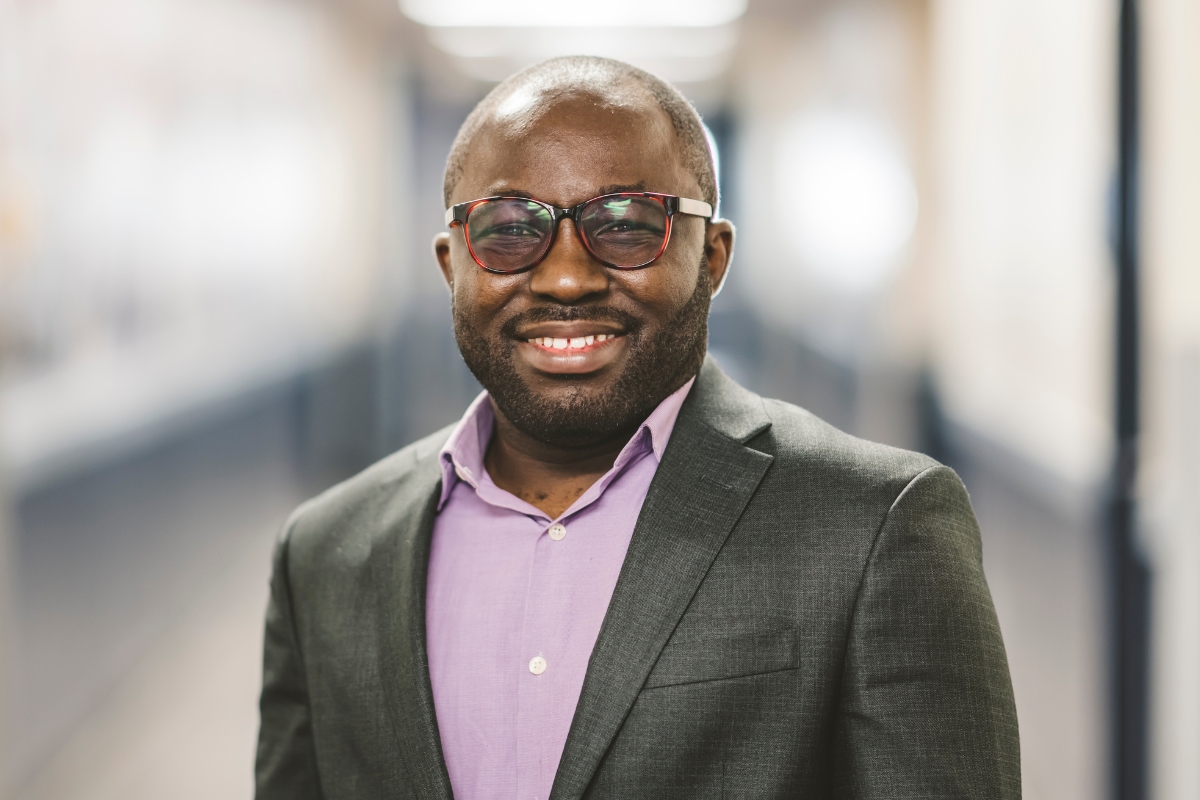
At the Idaho National Laboratory (INL), Temitayo Olowu holds a pivotal role at the forefront of energy evolution. He is developing critical advances to strengthen and secure America’s energy grid — the vast network of power lines, transformers and power plants that deliver electricity to homes, businesses, hospitals and schools that are the backbone of modern life.
“It’s exciting to be part of the process that is making the nation’s power grid more reliable, secure and cost-effective,” says Olowu, who received his Ph.D. in electrical engineering from FIU’s College of Engineering and Computing in 2021.
Olowu joined the INL in 2022 and today is lead control system research engineer. One of 17 national labs in the U.S. Department of Energy complex, the INL is home to more than 6,400 researchers and support staff focused on innovations in nuclear and energy security research.
As a youngster in Lagos, Nigeria, Olowu couldn’t have imagined that his obsession with discovering how things worked would take him nearly 8,000 miles from home to the high desert of Idaho Falls. “I really liked to build things,” he says. “I was always taking things apart to get them to run in a new way.” Radios, cassette players, electronic fans, electronics — if it had wires and components, he had to understand every inch of it.
“It was trial and error. I often failed. It wasn’t like I had the technical knowledge to make things work,” he acknowledges with a laugh.
While Olowu’s curiosity was first nurtured in his father’s workshop, where air conditioning systems were repaired, his education in engineering provided the foundation for his future. “I grew up in a highly technical environment. I was very interested in gadgets, and I was good at math. Engineering seemed like the right fit because it was analytical.”
After completing a master’s degree in electrical engineering in Nigeria, where he also worked as a university lecturer, Olowu decided to pursue his Ph.D. abroad. FIU’s program attracted him both for its strong academics and unique opportunities with industry partners, elements he discovered under the professor who would become his mentor — Arif Sarwat, Ph.D., director of the FPL-FIU Solar Facility and director of Engineering for Industry & Research Collaborations at FIU.
The direct collaboration with a major utility company, offered through The Energy Power Sustainability & Intelligence (EPSI) Lab at FIU, gave Olowu an invaluable experience that most graduate students never get. “What I saw and was able to do in the lab was amazing,” he says. “Being the hands-on guy that I am, Dr. Sarwat’s program with FPL and the research they were doing was fascinating. I didn’t just do simulations. I worked on live systems.”
As part of the EPSI Lab, Olowu helped to develop intelligent power grid systems, focusing on how to generate, transmit and deliver power in the most cost-effective and reliable way possible. His research spanned everything from integrating solar power and other renewable sources to ensuring grid cybersecurity. His team also concentrated on preventing and mitigating power problems during hurricanes, which is critical in Florida’s heavy storm environment.
Along with Sarwat and other FIU inventors, Olowu received four patents ranging from a portable emergency mobile source of power to a hybrid renewable energy source system.
When Olowu graduated and began applying to positions at national laboratories, his FIU foundation set him apart. “To be honest, the experience I had, the kind of research I did, was very key to me getting the job,” he says. “I had a Ph.D., but the hands-on experience I had with industry was a key factor, and I was able to demonstrate that I held leadership positions while at FIU.”
Now settled in Idaho with his wife, Oluwamayokun, and four children, Samuel, Elijah, Miracle and Marvelous, ranging in age from 3 to 11, Olowu reflects on his journey from Nigeria to Florida to Idaho with gratitude. “Coming from my background, coming to FIU changed everything for me.”
For current students, Olowu’s advice is straightforward: get involved early. “I would suggest volunteering in a lab,” he says. “Every professor is interested in getting students involved. Going to classes and getting a degree is important, but getting involved in a lab is a step toward the real world.”
Looking ahead, Olowu sees himself driving the conversations and changes that the energy sector urgently needs, from shaping the development of new methods of power generation to putting AI to meaningful use in making energy more reliable, secure and affordable. It’s about keeping the lights on — and so much more.