
By Adrienne Sylver
This summer, students from FIU’s College of Engineering and Computing have traded textbooks for turbines, torque specs and steel beams. They are the next generation of engineers already helping to build the future.
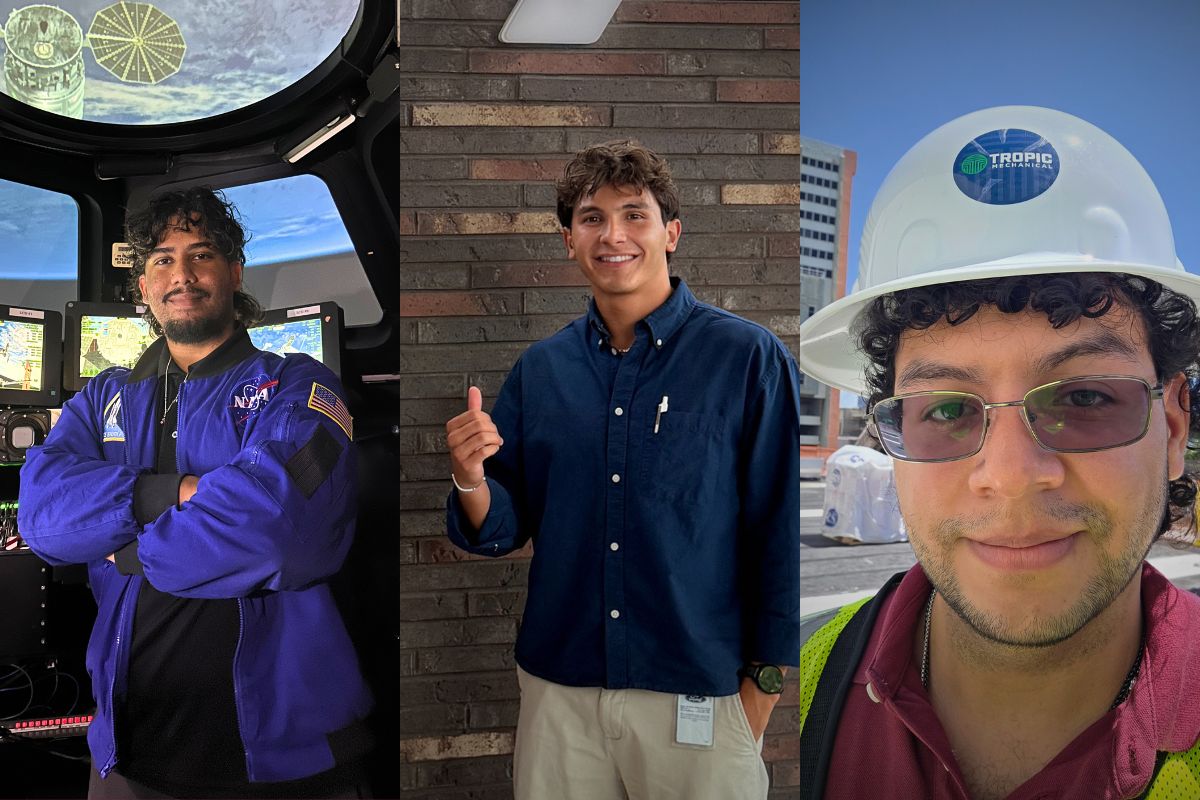
At NASA’s Marshall Space Flight Center in Alabama, Johnpaul Lopez-Burgos is working on the Falcon 9 program, helping ensure that the data behind one of the world’s most-flown rockets meets the rigorous standards required for spaceflight. In Michigan, Adrian Calderon is contributing to the development of Ford’s F-600 Super Duty truck, set to hit the market in 2029. And closer to home, Derek Valencia is gaining hands-on experience in construction management at Tropic Mechanical in Doral, learning how large-scale building projects come together from the ground up.
Three students. Three industries. One common thread: each credits FIU’s student organizations, including the Society of Hispanic Professional Engineers (SHPE), with helping them get there.
The largest national non-profit dedicated to assisting the Hispanic community reach its full potential in STEM, SHPE provides technical and soft-skill workshops, as well as funding for promising students to attend state and national conferences where the latest hot topics are discussed and where industry reps hold hiring events. All students are welcome to join SHPE.
From launch pads to assembly lines to job sites, Lopez-Burgos, Calderon and Valencia are proof that an FIU engineering education extends far beyond the classroom. Here’s a closer look at each of their journeys.
For Lopez-Burgos, a senior in FIU’s online Information Technology program, the internship at NASA is his sixth across four different centers. In his current role as Falcon 9 Data Certification Manager, he works alongside commercial and international partners to help certify launch readiness for both crewed and uncrewed missions, including preparations for the upcoming Crew 13 mission to the International Space Station.
“We are basically the team that helps ensure every Falcon 9 meets NASA’s certification standards before it can fly,” he explains, describing how his team’s work ensures every process is cleared. His internship path has taken him through NASA headquarters in Washington, D.C., where he worked on early AI chatbot architecture, to Johnson Space Center in Houston and Kennedy Space Center in Florida and has given him the opportunity to work with companies such as SpaceX and Amentum.
For Calderon, a rising sophomore studying mechanical engineering, Ford was a natural fit. “I was the kid who asked for wood for Christmas so that I could build things. I was always taking apart my toys and putting them back together. I’ve always loved cars. I’m fascinated by how incredible the engineering is,” he says.
At Ford, his work on the product development team supports the police vehicle fleet, including the Interceptors and F-150 Responders, and the Super Duty truck where he is focusing on the electrical system. One perk: riding along as vehicles are pushed to their limits on the test track.
For Valencia, a senior who returned to FIU for a second undergraduate degree in mechanical engineering after majoring the first time in finance and working several years in the field, landing the internship at Tropic Mechanical means a solid foundation for a new career. “It’s extremely valuable if you want to work in any sort of construction job or in management,” he says.
The rotational internship is proving broader than expected. “I’ve participated in many site visits and learned about projects from the ground up. I’ve had the chance to work with the estimating department and bid on jobs and, in the pre-construction phase, review design drawings. Next, we are working on building image modeling, similar to a CAD model but more mechanical systems based.”
Whether it’s certifying rockets for flight, engineering trucks that will hit the road for decades or learning the ins and outs of construction management, Lopez-Burgos, Calderon and Valencia are each gaining the kind of real-world experience that no classroom alone can teach.
Valencia sums up what organizations like SHPE have meant to his own journey. “Get involved,” he says. “SHPE is like a slingshot into an internship.” It’s a sentiment Lopez-Burgos and Calderon, who found their own paths through similar doors, share.