
By Adrienne Sylver
Every day, billions of dollars flow through the American economy. A new homebuyer wires funds for their dream house. Businesses transfer six-figure payments to suppliers. Federal agencies move critical funds across the country and abroad. These aren’t your typical Venmo or Cash App transactions. These are high-value, high-stakes wire transfers that keep commerce running smoothly.
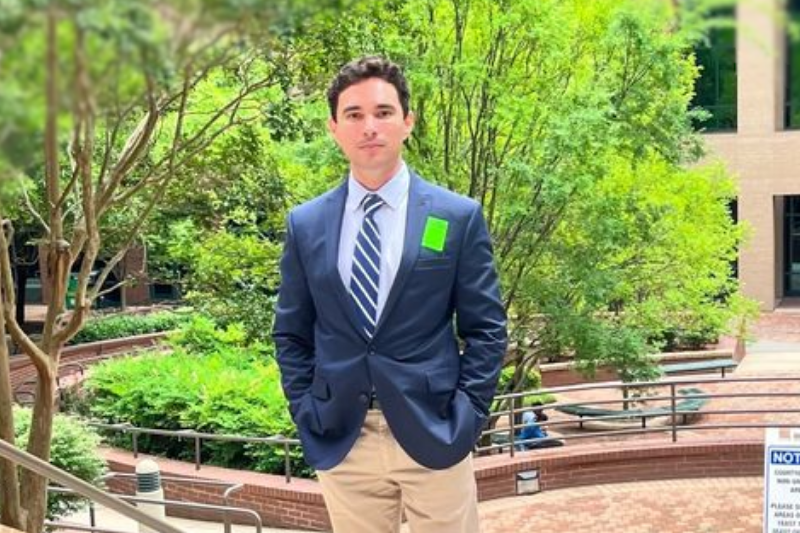
At the heart of this financial infrastructure is 2023 FIU computer science graduate Kenny Afonin, who works in FinTech as a systems operations engineer at Wells Fargo in Charlotte, NC. His team manages the core wire payment system — ensuring operational stability, compliance and optimization — to process trillions of dollars weekly for the bank.
“The impact of these wire transfers is very real and urgent,” he explains. “If the system goes down, people can’t send money. Our clients should face no issues with transfers coming in the door or going out the door.”
Afonin’s journey to this critical role began in his childhood home in Homestead, FL. There, his parents made a decision that shaped his future: They placed a computer in his room. He spent hours with friends playing video games, though none captivated him quite like Age of Empires, where players build a society from scratch.
“In Age of Empires, success means growth and being ranked the No. 1 civilization,” he says.
“While the game was the start of my interest in computers, it also piqued my interest in entrepreneurship. There’s much greater satisfaction in manifesting my own vision and growing my own enterprise than someone else’s."
By the time Afonin graduated high school, he knew he wanted to pursue computer science.
“I initially considered other schools, but FIU was making headlines. I thought the school was on a trajectory to improve its rankings and I believed it would provide a better education. It was the best decision I’ve ever made,” he acknowledges.
He particularly highlights the hands-on learning opportunities and industry connections that distinguished FIU’s programs. “The teachers didn’t just teach theory,” he says. “They prepared us for real-world applications. None of them made it easy. I spent most of my time in study hall, in the library and with tutors. But the professors taught me to work hard and to think analytically.”
Afonin emphasizes the importance of his FIU classes in programming, machine learning, math and statistics, crediting professors such as Kaoutar Ben Ahmed for data mining, Taje Ramsamujh for math/intro to combinatorics, and Ahmad Waqas for programming with Java.
The Java course proved particularly crucial because it came during the same semester he interviewed with Wells Fargo for his first internship.
The class went beyond fundamentals: “It taught me about effective programming and structure. It wasn’t just learning Java,” Afonin says.
“It was learning logical and efficient methods that you use to create something. It helped with interviews and even with my work today.”
Afonin’s focus on problem-solving caught the attention of the recruiter at Wells Fargo, and he completed a remote internship in the summer of 2021. That position led to a second internship in the summer of 2022, this time in Charlotte. During his internships, Afonin helped develop automated process to handle manual tasks, including building BOTs that could read, classify and direct emails to appropriate departments.
It wasn’t just his coursework at FIU that helped him secure two internships and ultimately, his job, he stresses. Through INIT, the largest tech organization at FIU, he participated in workshops that sharpened his skills in interviewing and building a stronger resume.
Afonin also emphasizes the importance of FIU Career Services, which was instrumental in connecting Afonin with opportunities that would define his career trajectory.
“Their internship services are top notch. I would get emails almost every day about new internship or job opportunities,” Afonin says.
His experience at FIU was so profound that Afonin is now pursing his MBA through the university.