
Student success at a large university is not the result of one program. It is the product of teamwork. At FIU, we have spent years building exactly that outcome.
Our No. 1 ranking for upward social mobility is the result of that kind of coordination meeting outstanding students where they are.
This issue is about the people and programs behind our improving student success metrics here at the College of Engineering & Computing.
The programs below highlight just a portion of the college-led initiatives to help our Panthers thrive.
Building the Pipeline
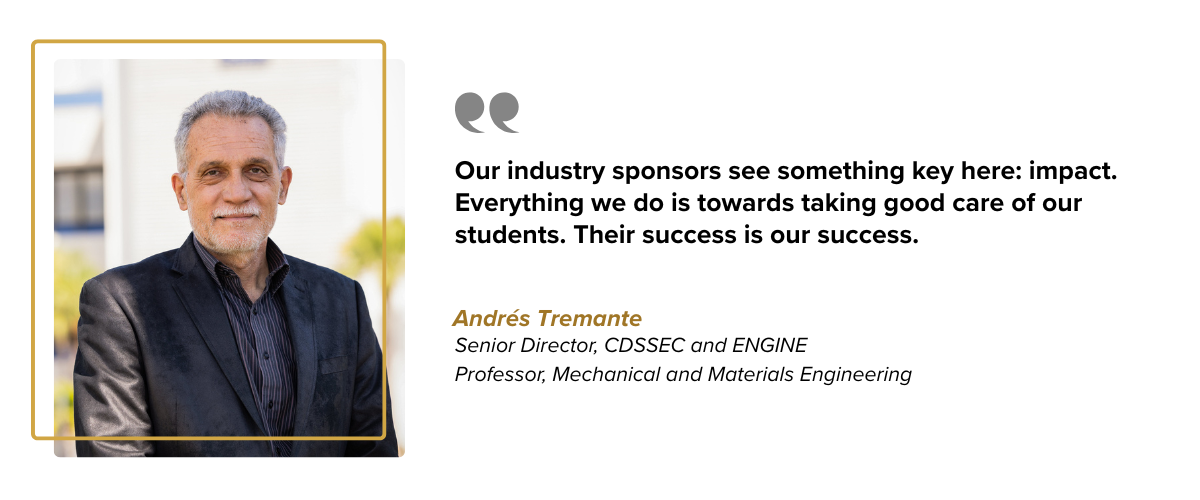
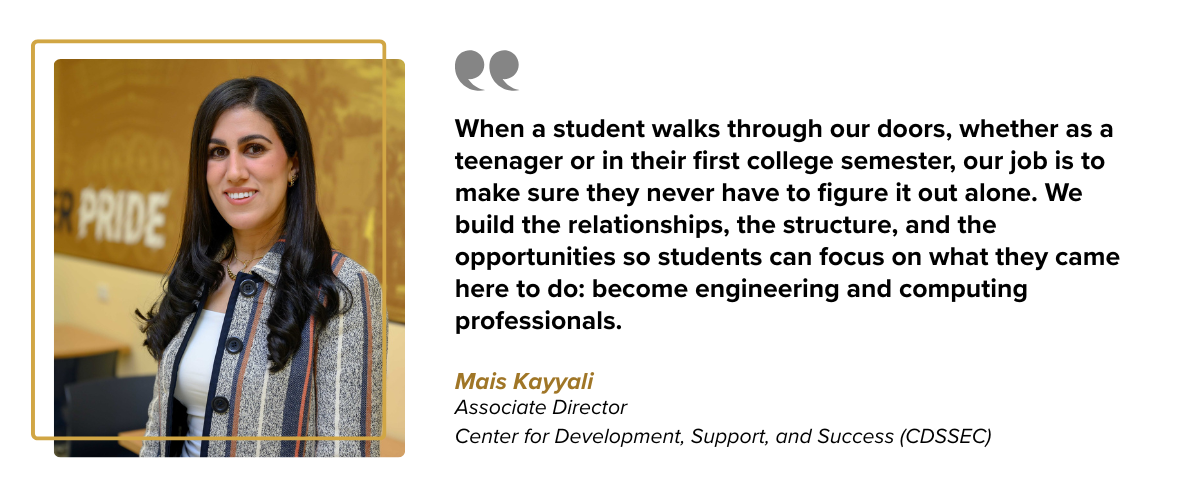
One of the programs at the heart of our student success infrastructure is CDSSEC, the Center for Development, Support, and Success in Engineering and Computing. Under Professor Andrés Tremante, Associate Director Mais Kayyali, key staff members, four Ph.D. students serving as graduate assistants, and several undergraduate and graduate student assistants, CDSSEC operates as a K-20 pipeline: a single, integrated engine that reaches students as early as elementary school and seeks to support them through college, research, and into careers.
The center touches students at every stage of their education, through programs like:
- Engaging Latino Communities in Education (ENLACE) and Engineers on Wheels, which bring engineering education to local K–12 schools free of cost,
- the Florida Action for More Engineering (FLAME) dual-enrollment partnership, and
- the Opportunities for Undergraduate Research and Scholarship (OURS) undergraduate research program.
It’s a mission that’s earned CDSSEC financial support from many of the U.S.’s biggest companies.
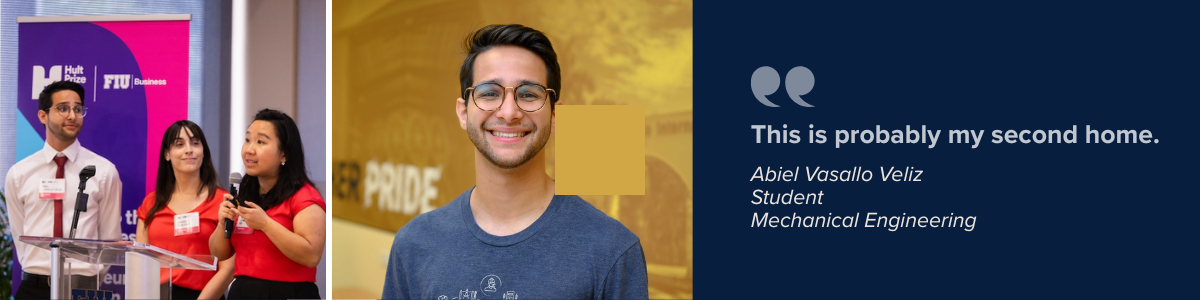
No story captures this better than that of Abiel Vasallo Veliz, a mechanical engineering senior whose FIU connection began before he ever declared a major. Through the Precise Advanced Technologies and Health Systems for Underserved Populations (PATHS-UP) NSF Engineering Research Center, CDSSEC placed Abiel as a junior scholar in the Medical Photonics Laboratory — when he was only a sophomore at Hialeah Gardens High School.
Today, Abiel is a researcher contributing to a handheld polarized-light imaging device designed to detect early collagen breakdown in the cervix and predict preterm birth risk. This spring, Abiel and teammates Amanda Sanchez and Jenny Pei won FIU’s campus competition for the Hult Prize (often called the “Nobel Prize for students”). They were subsequently invited to compete on the Hult Prize’s national stage for $1 million in seed funding.
In the meantime, Abiel has accepted a summer internship with Honeywell in testing validation and plans to complete his master’s degree through FIU’s 4+1 program. Along the way, he became an Engineers on Wheels student assistant and helped give back to incoming FLAME students — the same pipeline that launched him.
Kayyali, who is currently pursuing her Ph.D. in Engineering and Computing Education, sees Abiel’s journey as exactly what the center is designed to produce.
From Classroom to Career
When Gabriela Rodriguez came to FIU, she was a math major working in healthcare — not a computer science student, and not a basketball fan. A summer program with Break Through Tech introduced her to computing and changed her direction entirely. She switched to computer science, earned a spot in a Miami HEAT internship cohort, and spent three weeks building predictive models on transaction data for the HEAT's 601 Analytics company. They brought her back. When she graduated, they offered her a full-time position. Read her full story here.
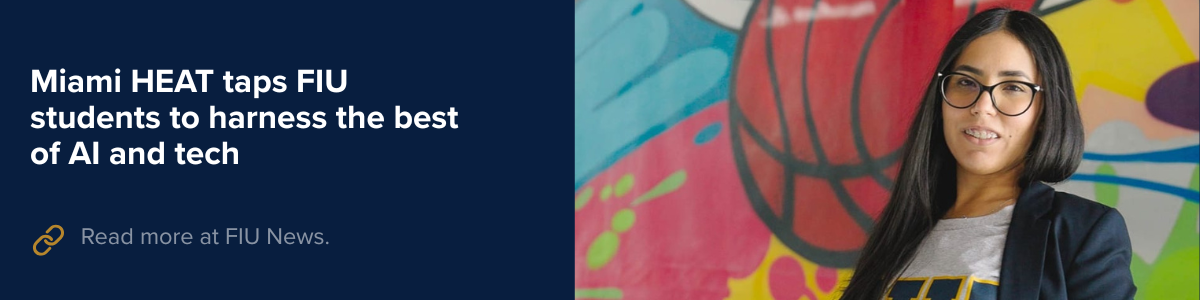
Gabriela is one of nearly 300 students that our college has supported through the Break Through Tech Sprinternship™ program. These are paid, three-week micro-internships that place student teams inside real companies working on real world business challenges. The model, designed by the national Break Through Tech team and run through FIU’s Sprinternship program, is no-interview by design, and students’ success depends on their ability to contribute to the success of the team’s challenge project.
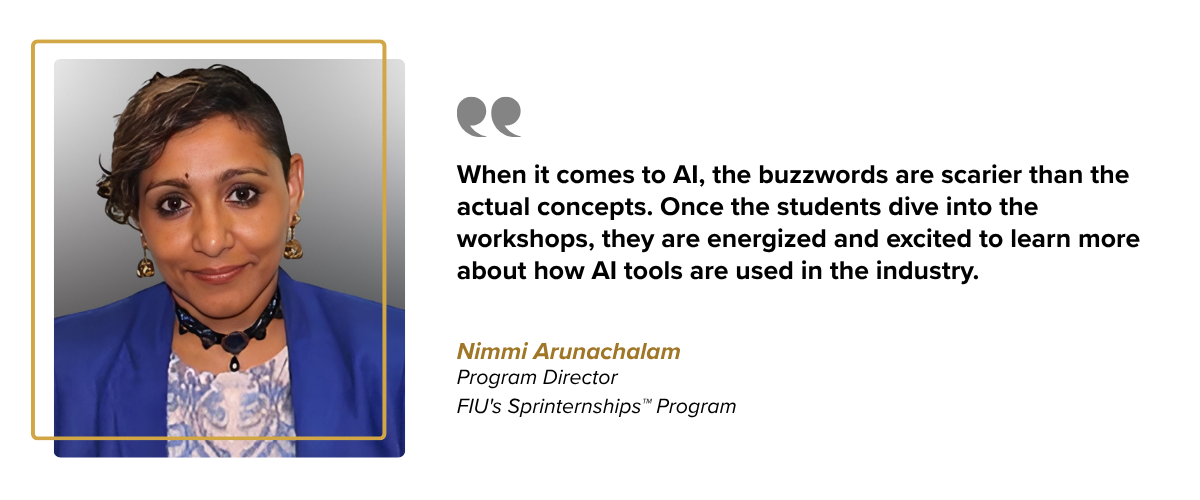
But students don't arrive unprepared. Before each cohort begins, FIU provides seven weeks of intensive technical and professional training. That recently included workshops in full-stack web development and data science and AI, where students learned to clean and analyze data, design and evaluate models, and practice using AI tools that are becoming commonplace across industries. New industry partners taking FIU Sprinterns include Royal Caribbean Group, with LexisNexis Risk Solutions expanding an existing relationship.
The workshops are led by student facilitators: peers with advanced technical skills trained to lead workshops by Program Director Nimmi Arunachalam, a former high school computer science teacher of 12 years. She works closely with these student leaders, who are well-versed in these tools, to build an engaging curriculum using industry-standard practices that help demystify emerging topics in tech.
The Work Behind the Numbers
Behind every graduation rate sit teams of professional advisors who meet with students every day, building custom study plans and advocating for them one at a time. Our advising team conducts student-by-student graduation checks three times per year — an intentional practice that directly shapes course offerings and ensures students have what they need to stay on track.
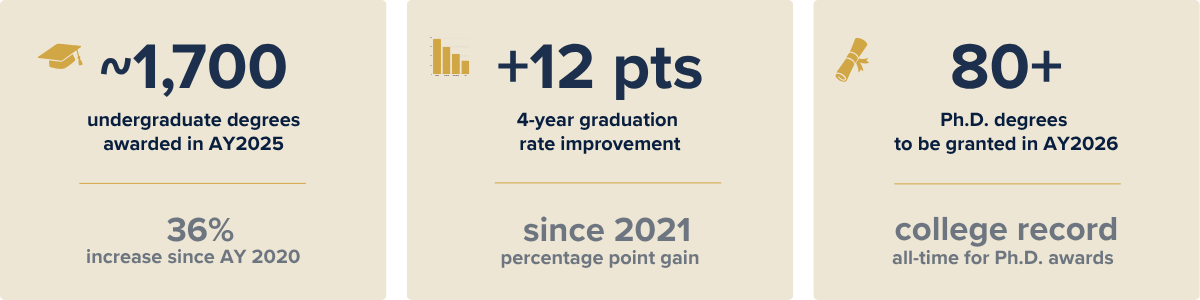
The effort shows. Our four-year graduation rate has increased by more than 10 percentage points since 2021, reaching the mid-60% range, reflecting stronger on-time completion. At the same time, we continue to graduate more students than ever before, with undergraduate degrees up significantly in recent years, even as enrollment has grown rapidly, demonstrating our ability to scale student success.
“We don’t wait for students to fall behind,” says Mario Sanchez, Director of Advising Services. “We know their names, we know their plans, and when something stands between them and graduation, we go find it before they have to.”
Removing the Barriers
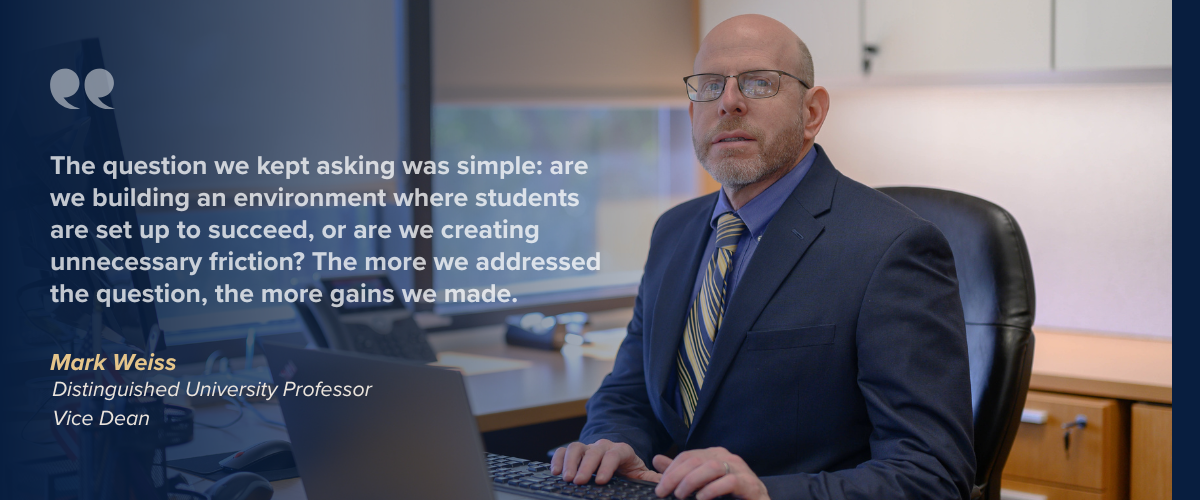
Our graduation rate gains did not come from one fix. They came from a sustained, systematic effort to identify and remove unnecessary obstacles between our students and their degrees.
Under Vice Dean Mark Weiss, CEC undertook a comprehensive review of class offerings, room sizes, scheduling, and prerequisite chains. His team led department-by-department efforts to eliminate requirements that created roadblocks without adding value; redistributing course content where needed; and expanding summer course availability to give students greater flexibility.
Looking Ahead
CEC will launch an AI Minor in Fall 2026, open to students across all engineering and computing majors. This will give our students not only AI knowledge, but also a solid signal on their transcripts and resumes that communicates AI-readiness. In a moment when nearly every industry partner is asking for AI fluency, credentials like these matter.
As I close this message, I want to take a moment to acknowledge that this will be my final contribution to this series. It has been a privilege to share the work of this remarkable college with you each month: the researchers pushing the boundaries of what engineering and computing can do, the students who remind us why this work matters, and the partners who make it possible. FIU’s College of Engineering & Computing is in an extraordinary moment of growth, and I look forward to watching, now from a different vantage point, as new leadership carries it further. Thank you for reading, for engaging, and for being part of this community.
Sincerely,
Inés R. Triay
Interim Dean, FIU's College of Engineering and Computing