

When Raul Herrero walked into a blockchain workshop last fall with fifteen other FIU students, he didn't just witness the future of decentralized technology. He saw the culmination of his studies at FIU.
Students connected their laptops to a 17-node Raspberry Pi cluster and, within hours, were sending transactions on the Cardano practice network. For Herrero, a December 2025 computer science graduate now heading to law school, the experience crystallized something profound.

"As a computer science major, you work your way up in your understanding of blockchain, from algorithms to encrypted networks to the foundation of cryptocurrencies," Herrero said.
"But to actually put these theories to work in real devices—it just felt like a cap on everything I've learned as an undergrad."
This hands-on workshop represents something larger happening at FIU's College of Engineering & Computing. We're preparing students to shape blockchain's future across industries, from cybersecurity to law to artificial intelligence.
A Growing Blockchain Ecosystem
FIU's blockchain leadership spans research labs, innovative coursework, and notable alumni success. For example, CIERTA – the Center for Integrated Security, Privacy, and Trustworthy AI – focuses on cryptocurrency security, cryptojacking detection and decentralized autonomous organizations. The cybersecurity hub is led by our innovative faculty: Director Selcuk Uluagac, an Eminent Scholar Chaired Professor, and Associate Director Mohammad Ashiqur Rahman, an Associate Professor.
One recent example of innovation: Hadi Amini, associate professor of computer science, is developing blockchain-based federated learning to protect AI systems from data poisoning attacks. Working with a team of Ph.D. students, Amini uses the same decentralized blockchain technology behind cryptocurrencies to add extra layers of protection to autonomous vehicles and other AI-powered systems.
Teaching What Few Universities Teach
At the heart of our blockchain education initiative is Associate Teaching Professor Kianoosh Boroojeni, who is developing several blockchain courses at FIU (a rarity among universities). His senior-level course, CIS 4731: Blockchain Technologies, provides students with deep theoretical knowledge in consensus algorithms, encryption methods and the mathematical foundations underlying cryptocurrencies.
Boroojeni recognized that pairing academic rigor with practical experience creates the most prepared graduates. That's where industry partnership becomes essential.
The Cardano Workshop: Turning Knowledge Into Action
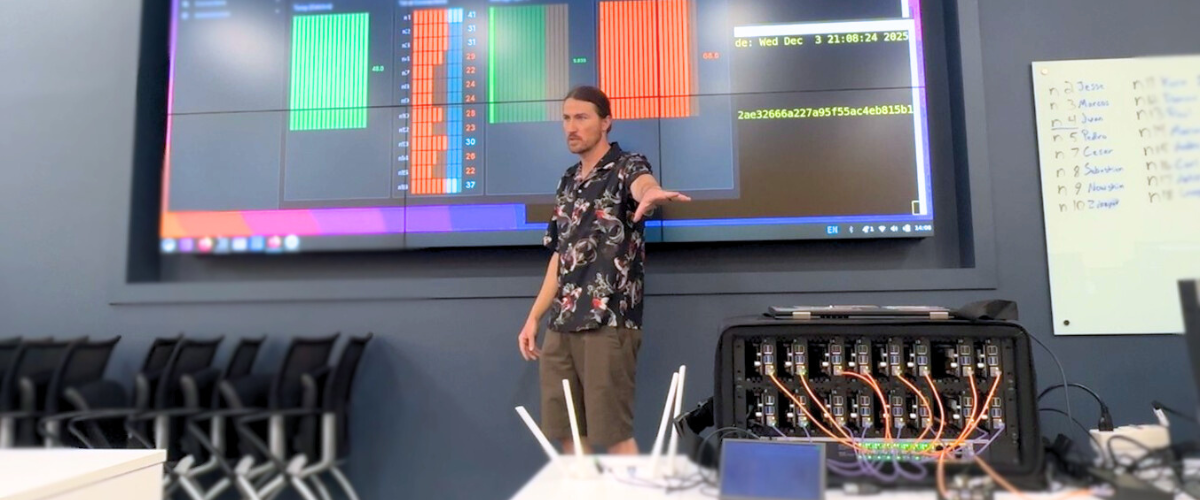
Last fall, through a collaboration with Cardano (a blockchain platform co-founded by Charles Hoskinson and Jeremy Wood), instructors flew from Mexico and Wyoming to FIU to lead an intensive four-hour workshop for Dr. Boroojeni's blockchain students, with additional expert contributors joining virtually from Cantabria, Spain, and locally from South Florida. The partnership was facilitated by Juan Sierra, a member of Cardano's Product Committee who connected the college with Input-Output Global's education team. What they brought: a 17-node Raspberry Pi cluster networked together in a single box.
This wasn't just a demonstration. Students connected their laptops to the cluster and, through terminal commands, sent transactions on the Cardano practice network and observed how blockchain nodes recorded them in real time. The hardware setup consumed less energy than a few light bulbs, Boroojeni says, yet gave students direct experience with how decentralized blockchain networks operate.
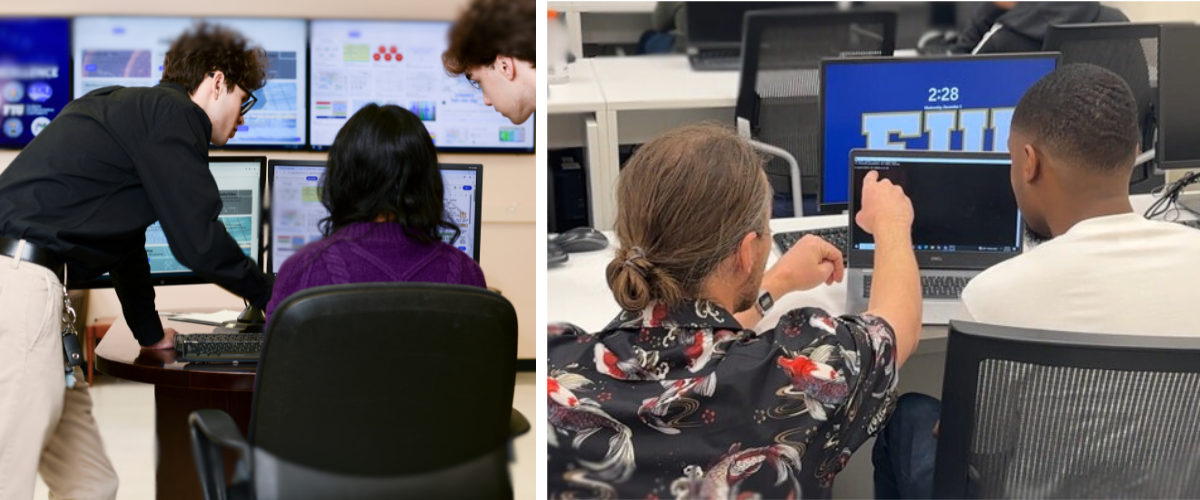
The workshop introduced students to Aiken, a developer-friendly smart contract language for Cardano that lowers the barrier to entry for blockchain development. Students progressed from setup to sending transactions and observing network consensus within hours.
For Mariana Phelan, a computer science senior now interning at Apple in data analytics, the workshop illuminated blockchain's practical requirements and security capabilities.
"The program is really heavy, so no laptop can do that on its own," Phelan explained. "You need at least a desktop and a lot of RAM to run the blockchain on the server. Seeing how those blocks connect with each other and speak to each other, that's when you can really see what blockchain is doing."
The educational approach resonated across different student career paths. Herrero, whose computer science background will inform his future legal career, found particular interest in smart contracts (self-executing agreements that combine traditional legal contracts with programming logic).
When Herrero mentioned his plans to attend law school, the representatives were enthusiastic.
"They're like, 'That's awesome. We need more tech-savvy lawyers, especially in the blockchain community,'" he recalled. "There's clearly a desire for that from the industry."
Building for Tomorrow
What ties these elements together (award-winning alumni, cutting-edge research, innovative coursework, and industry collaboration) is our commitment to preparing students for a rapidly evolving technological landscape. The digital revolution we're experiencing demands graduates who understand not just how to use emerging technologies, but how to build them, secure them and deploy them.
That's the kind of education that defines FIU's College of Engineering & Computing.