
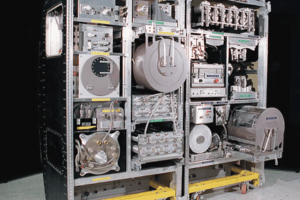
A close-up view of the water recovery system’s racks – these contain the hardware that provides a constant supply of clean water for four to six crew members aboard the ISS.NASA
When you’re on a camping trip, you might have to pack your own food and maybe something to filter or treat water that you find. But imagine your campsite is in space, where there’s no water, and packing jugs of water would take up room when every inch of cargo space counts. That’s a key challenge engineers faced when designing the International Space Station.
Before NASA developed an advanced water recycling system, water made up nearly half the payload of shuttles traveling to the ISS. I am an environmental engineer and have conducted research at Kennedy Space Center’s Space Life Sciences Laboratory. As part of this work, I helped to develop a closed-loop water recovery system.
Today, NASA recovers over 90% of the water used in space. Clean water keeps an astronaut crew hydrated, hygienic and fed, as it can use it to rehydrate food. Recovering used water is a cornerstone of closed-loop life support, which is essential for future lunar bases, Mars missions and even potential space settlements.
Read more at FIU News.