
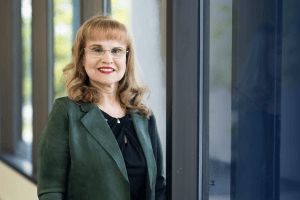
Florida is building a quantum future, and FIU is helping to engineer it.
Last month at Quantum Beach 2025 in West Palm Beach, our college joined representatives from 16 other Florida universities in announcing a bold, statewide commitment to quantum technology. Alongside the Florida Department of Commerce, we unveiled a joint framework to accelerate quantum research, workforce development and entrepreneurship across Florida.
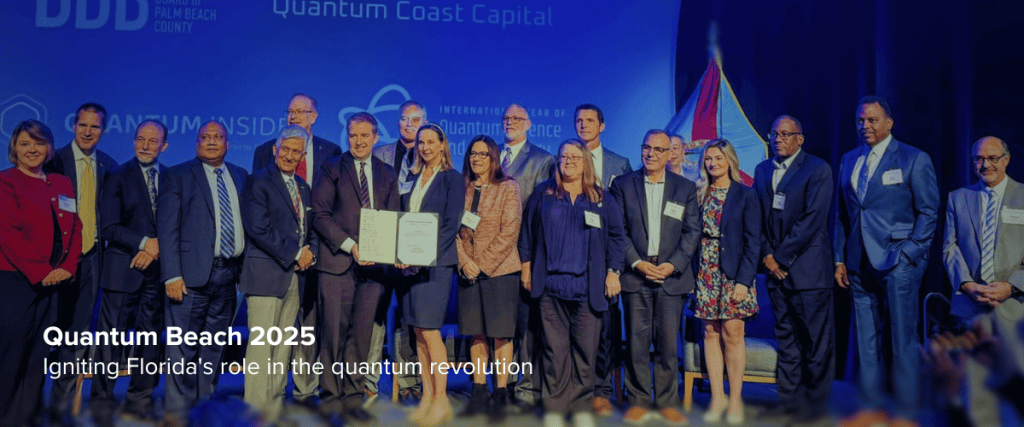 This moment positions our state as a national quantum hub, and FIU as a key driver of Florida’s rise. Our faculty are already tackling the fundamental challenges that will define quantum's future, spanning computing, energy, cybersecurity, materials science and more.
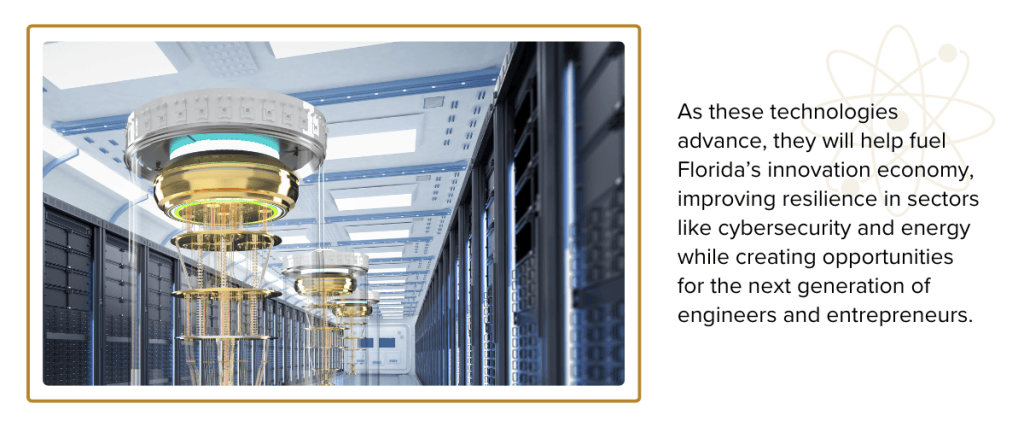
As these technologies advance, they will help fuel Florida’s innovation economy, improving resilience in sectors like cybersecurity and energy while creating opportunities for the next generation of engineers and entrepreneurs.
Here are just a few of the innovative quantum research initiatives happening at FIU.
Targeting the Qubit Control Challenge
Aleksandr Krasnok, an assistant professor in the Department of Electrical and Computer Engineering, is tackling one of quantum computing’s biggest roadblocks: reliably controlling qubits as systems grow larger.
A major limitation in today’s quantum computers is “crosstalk.” When researchers try to control one qubit, nearby qubits often react unintentionally because they’re packed so closely together. As more qubits are added, this interference gets worse, creating noise that limits performance and prevents quantum computers from scaling.
In a recent publication, Krasnok and his team show that special kinds of electromagnetic signals, ones described with both real and imaginary numbers, may allow researchers to control a single qubit without disturbing others.
This research direction is part of a broader effort on complex-frequency excitations recently summarized in a 2025 Science review that Krasnok co-authored, “Complex-frequency excitations in photonics and wave physics.”
Overall, the approach could dramatically reduce interference in future quantum systems.

Pioneering Quantum Artificial Intelligence
Associate Professor Himanshu Upadhyay is advancing quantum artificial intelligence by designing new algorithms that can tackle challenges in cybersecurity, energy and network protection.
His research focuses on quantum versions of AI systems that can process information faster than their classical counterparts. His team is developing quantum models that identify cyberattacks and network threats in real time and demonstrate better detection performance than traditional systems.
Upadhyay’s group is also contributing to “green quantum computing.” They study how much energy different quantum AI methods use and find ways to reduce interference without sacrificing performance. Their goal: help ensure that future quantum AI systems remain powerful and efficient.

Building a “Save” Button for Quantum AI
Associate Professor Janki Bhimani of the Knight Foundation School of Computing and Information Sciences is addressing a major obstacle in quantum system design, particularly in quantum machine learning: the inability to save progress during training.
Unlike classical systems, quantum computers cannot easily store intermediate results. When a quantum machine learning (QML) process fails partway through, researchers often have to start over, which wastes both time and resources. Applying classical checkpoint and restore methods to QML systems typically results in unstable training. This limitation restricts the potential of quantum AI.
Dr. Bhimani’s recent publication offers a promising breakthrough. Her team shows that by storing quantum specific metadata, along with key system information like hardware noise patterns, quantum models can resume training, make smarter restart decisions and significantly improve training efficiency. This kind of reliability could help bring quantum-powered tools into real-world applications.

Deep Partnerships Advancing Quantum Materials
Professors Daniela Radu and Cheng-Yu Lai from the Department of Mechanical and Materials Engineering have built a strong research network across multiple federally funded centers to develop new materials for quantum technology.
Radu creates ultra-small quantum dots for single photon emitters. These are essential building blocks for new qubits, which are essential for quantum communication and computing. Lai designs and engineers novel quantum crystals as light converters, helping to bridge and integrate various quantum devices.
Their work addresses a central problem: Many existing materials cannot meet the strict requirements of quantum systems. Their innovations open new possibilities for quantum sensors, secure communication tools and quantum computers.
Their collaborations span NSF programs in Quantum Information Science and Engineering (QISE); Department of War initiatives related to quantum materials and energy resiliency; and NASA projects in optical and electronic materials. Together, they are training future quantum engineers with hands-on experience in materials and device design.

Bringing Quantum Science Into the World of Energy
Distinguished professor Osama Mohammed is leading efforts to apply quantum computing and quantum science to power grids, renewable energy systems and cybersecurity. These are areas where speed, accuracy and resilience are critical.
Quantum computers can outperform classical systems on certain optimization problems. Turning that advantage into practical tools, however, requires deep knowledge of both physics and engineering. Mohammed’s research bridges this gap while addressing vulnerabilities in modern energy systems.
His team works on quantum optimization techniques for scheduling microgrids; quantum-based sensors for measuring electromagnetic fields; and quantum key distribution to secure critical infrastructure. The group is also developing hybrid quantum-classical learning methods to detect anomalies in smart grids. Simultaneously, his team is exploring quantum machine learning models for forecasting renewable energy production based on weather patterns and usage data.

Florida is moving quickly to claim its place in the quantum era, and FIU is helping lead the charge. This is only the beginning; I look forward to keeping you updated about the discoveries and talent keeping Florida at the forefront of quantum innovation.
Sincerely, Inés R. Triay Interim Dean, FIU's College of Engineering and Computing