
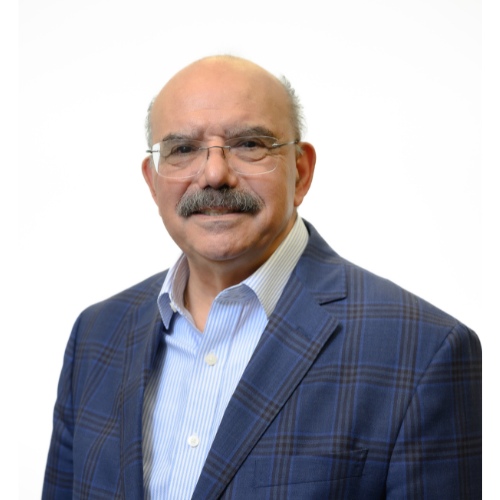
Biography
Prof. Volakis is an IEEE, ACES, AAAS, NAI, URSI and ASEMFL Fellow. He served as Dean of Engineering and Computing at FIU from 2017-2023. His career spans 4 decades: 2 years at Boeing, 19 years on the faculty at the Univ of Michigan and 15 years at Ohio State, and 8 years at FIU. He is the recipient of the 2026 IEEE Electromagnetics medal and the 2026 USNC-URSI Distinguished Radio Science Award.
After his Ph.D. in 1982, he was recruited by North American Aircraft Operations (now part of the Boeing Company), where he carried out critical design innovations for the B1-B bomber and later for the B2 program. He began his academic career at the University of Michigan-Ann Arbor in 1984. During 1984-2003 he played a key role in reviving the Radiation Laboratory into becoming the leading RF/Electromagnetics lab worldwide. At the Michigan Radiation Lab, he graduated nearly 45 Ph.D.s/Post-Docs and also served as its Director. During his time at Michigan, he led a large group of students and researchers, developed novelties in diffraction and radar scattering, particularly as relates to impedance/material surfaces, and played a key role in establishing the finite element method as one of the most popular Microwave/Electromagnetics analysis toolsets, now found in several commercial packages. He also supported the commercialization of these packages by working with start-up companies.
In 2003, he was recruited by his alma mater, The Ohio State University, to lead the historic ElectroScience Laboratory. At Ohio State, he was the Roy and Lois Chope Chair in Engineering and a Professor in the Electrical and Computer Engineering Dept. (2003-2017). He served as the Director of the Ohio State Univ. ElectroScience Laboratory for 14 years. During this time, ElectroScience reached 170 faculty, researchers and staff, and acquired a new 40,000 ft2 building to support its growth. More importantly, ElectroScience became a leading RF/electromagnetics center, growing from $3.5MM per year in funding to nearly $15MM per year at its peak.
After a highly successful period at Ohio State, he was appointed Dean of Engineering and Computing at Florida International University (FIU), one of the largest Colleges in the U.S. based on student population. During his time as Dean, the College’s student population also grew from approximately 5400 to 8700 students, while its U.S. News and World Report rankings improved by more than 40 points to reach #61 among public Universities in 2023. Concurrently, eight of its programs reached top 50 status. Also, in less than 7 years, the College’s four-year graduation rate increase from nearly 19% in 2017 to 60% in 2023, and its research expenditures grew 3-fold, reaching $75M. Further, he established a robust fundraising team with an exciting college alumni advisory team that led to $125M in external fundraising.
Prof. John L. Volakis was elected Chair of the International Radio Science (URSI) (2021-2023), voted by nearly 45 countries. He also served as Vice Chair of URSI-B from 2017-2021. He was elected and served as President of the IEEE Antennas and Propagation Society in 2004.
Prof. Volakis is one of the most active researchers in electromagnetics, RF materials and metamaterials, antennas and phased array, RF transceivers, textile electronics, millimeter waves and terahertz, EMI/EMC as well as EM diffraction and computational methods. He is also the authors of 9 books, including the Antenna Handbook, referred to as the “antenna bible.” He is recognized worldwide for introducing and/or establishing 1) hybrid finite method for microwave engineering, now defacto methods in commercial RF design packages, and helped establish two major traded companies, 2) novel composite materials for antennas & sensor miniaturization, 3) a new class of wideband conformal antennas and arrays with over 30:1 of contiguous bandwidth, referred to as tightly coupled dipole antennas, a key innovation for the future high data rate wireless links, 4) textile surfaces for wearable electronics and sensors, 5) battery-less and wireless medical implants for non-invasive brain signal collection, 6) diffraction coefficients for material coated edges, and for 7) model-scaled radar scattering verification methods to minimize costly full scale airframe field measurements.
He published over 475 journal papers, more than 1100 conference papers, 30 chapters, and 48 patents/disclosures. In 2004, he was listed by ISI Web of Science as one of the top 250 most referenced authors, and as of Dec 2024, his google h-index=84 with ~37000 citations. He has mentored nearly 120 Ph.Ds/Post-Docs and has written with them 50 papers that received best paper awards. Among his students, 25 are faculty members, several became leaders at major corporations and at least 10 started their own companies. He is one of the most active and cited researchers in electromagnetics/wireless/RF, RF materials and metamaterials, antennas and phased array, RF transceivers, textile electronics, millimeter waves and terahertz, EMI/EMC as well as EM diffraction and computational methods. He is also the authors of 9 books, including the popular Antenna Handbook, referred to as the “antenna bible.”
His work has been recognized by several international and University-wide awards during his career. Among them are: 1) Univ. of Michigan College of Engineering Research Excellence award (1993), 2) IEEE Tai Teaching Excellence award (2011), 3) IEEE Henning Mentoring award (2013), 4) IEEE APS Distinguished Achievement award (2015), 5) Ohio State Univ. Distinguished Scholar Award (2016), 6) Ohio State ElectroScience Lab Sinclair award (2016), and the 7) International Union of Radio Science Booker Gold Medal (2020), one of the most international prestigious awards in radio science/microwaves. He has been selected to receive the 2026 IEEE Electromagnetics Award/Medal for “contributions to computational electromagnetics and antenna technologies.”
Approx 25 of his former students have become leaders in industry and academia.
COMMERCIALIZATION ACTIVITIES
• Introduced and developed hybrid finite element methods for electromagnetics, and pioneered textile electronic technologies for wearable sensing. Notably, he verified the accuracy and commercialized finite element methods for RF/microwave circuits and antenna design, now the standard among commercial RF simulation packages. He initially transitioned the method to HP/ANSYS HFSS and later co-started the company EMSS -USA (now part of ALTAIR) to fully commercialize these toolsets in the U.S. and worldwide. These toolsets are now used by 1000s of companies for antenna design on platforms, RF/microwave circuit design, EMI/EMC, wireless power delivery and for automotive sensor integrations, among many other applications. They are the equivalent of CAD packages used in Mechanical design and Building Construction.
• Introduced the first implanted and battery-less sensor for wireless brain recorders, modernized wireless power harvesters. This is implant has been effectively tested in rats and swine, and is now being prepared for human evaluation with a focus on assessing epilepsy and Parkinson’s.
• Invented the unique ultra-thin and conformal ultra-wideband antenna arrays, referred to as tightly coupled dipole arrays (TCDAs). His tightly coupled dipole arrays (TCDAs) is a historic development for ultra-thin/conformal and ultrawideband beamformers, reaching millions of google hits within a 10 year period. This technology is currently being applied across many airborne and future 6G platforms. The arrays are over 5-fold smaller in size and a replacement of the much heavier and less effective Vivaldi antenna arrays. No other antenna system has achieved 50:1 of contiguous bandwidth, making the plethora of individual antennas on aircraft and other major platforms an outdated design approach. TCDAs are becoming the standard electronic scanning arrays for defense platforms and are slowly replacing Vivaldis for airframes and small airborne vehicle platforms due to their inherent multifunctionality and small form factor.
•Supported at least 10 of my Ph.D. students in their company start-ups. Among them are: Altair: https://www.altair.com/ (acquired by Siemens), PaneraTech: https://www.paneratech.com/, Nikola Labs: http://www.nikola.tech/, TeraProbes, Inc: http://www.teraprobes.com/wp/, Virtual EM, Inc: http://virtualem.com/, Savi Technologies: https://www.savi.com/, Monarch Antennas: http://www.monarchantenna.com/, and Novaa, ltd: http://novaarf.com.
Awards & Honors
- Fellow of IEEE, ACES, AAAS, NAI, URSI and ASEMFL
- 2026 Recipient of the IEEE Electromagnetics Award (highest career award in my field)
- 2026 USNC-URSI Distinguished Radio Science Award, https://usncursi.org/usnc_awards.php
- 2025 Fellow, Academy of Science, Engineering and Medicine of Florida (ASEMFL).
- 2025 Namesake travel grant award established by IEEE: https://www.ieeeaps.org/jvtg
- 2025- Chair, IEEE APS Fellows Committee
- 2025- Steering Committee, IEEE Journal of Selected Topics on Electromagnetics, Antennas and Propagation (JSTEAP), https://enotice.vtools.ieee.org/public/133694
- 2025- Track Editor of IEEE Antennas and Propagation Letters, http://awpl.ee.cuhk.edu.hk/about.html
- 2017-23 International Radio Science Union (URSI), Commission B Chair and Vice Chair
- 2015-17 Commission B Chair, USNC/URSI
- 2010-14 IEEE-wide Fellows Evaluation Comt.
- 2004 President, IEEE Antennas and Propagation Society (>10,000 members).
- 2003-16 Director, Ohio State Univ. ElectroScience Lab.
- 1998-00 Director, Radiation Laboratory, Univ of Michigan
- Google h-index: 84 (~37,000 citations); i10-index=487 http://scholar.google.com/citations?hl=en&user=JakmyDIAAAAJ
Education
- Ph.D., The Ohio State University, September 1982
- M.Sc., The Ohio State University, December 1979
- B.E., Summa Cum Laude, Youngstown State University, June 1978